



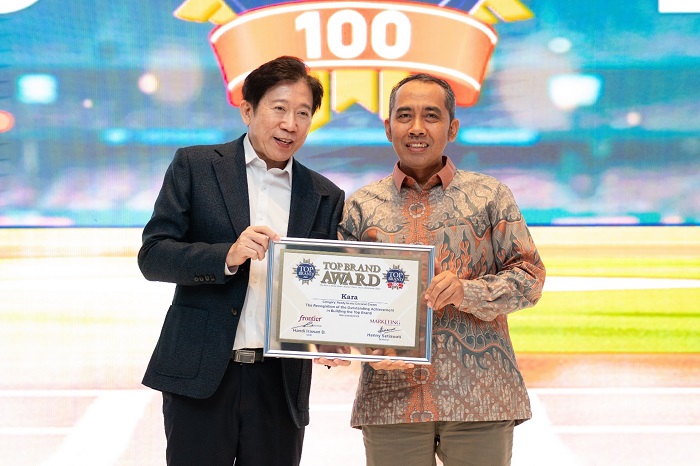
The leading coconut derivative brand, KARA, has once again proven its market dominance by securing two prestigious trophies at the 2026 Top Brand Awards. The grand awarding ceremony took place at the InterContinental Jimbaran, Bali, on Thursday (Feb 5, 2026). During the event, KARA earned the Top Brand 100 2026 title for the Ready-to-Use Coconut Milk category with a highly dominant Top Brand Index (TBI) of 86.80%. Additionally, KARA Nata de Coco successfully retained its Top Brand 2026 title, further cementing consumer trust in its product quality.
The award for the coconut milk category was received directly by the Head of General Trade of PT Kara Santan Pertama, Juwadi, from the CEO of Frontier, Handi Irawan D. Meanwhile, the award for the Nata de Coco category was accepted by the Head of Modern Trade of PT Kara Santan Pertama, Sorta Simanjuntak. Andiyanto Lie, Sales and Marketing Director of PT Kara Santan Pertama, stated that this achievement validates the company's consistency in maintaining quality amidst a dynamic market."This award serves as a strengthening market legitimacy for KARA. We view it as a validation of our consistency in maintaining quality, expanding distribution, and presenting innovations that are relevant to Indonesian consumers," said Andiyanto.
Andiyanto further explained that this success aligns with the #KARAborasi Lintas Generasi (Cross-Generational Collaboration) campaign. Through this spirit, KARA aims to engage Gen Z, Millennials, and MSME players to continue preserving coconut-based culinary heritage. "For years, KARA has been a loyal companion in the kitchens of Indonesian mothers. Now, we invite the current generation to carry on the relay of a flavor heritage built on love and togetherness," he added.
KARA is part of the Sambu Group, a pioneer in the coconut industry founded in 1967 by Tay Juhana. With its production base in Indragiri Hilir, Riau Province, the company is deeply committed to empowering local farmers. Notably, 90% of KARA’s coconut raw materials are sourced from Indonesian farmers, meaning every product purchased contributes directly to the socio-economic welfare of the communities surrounding the industry.